
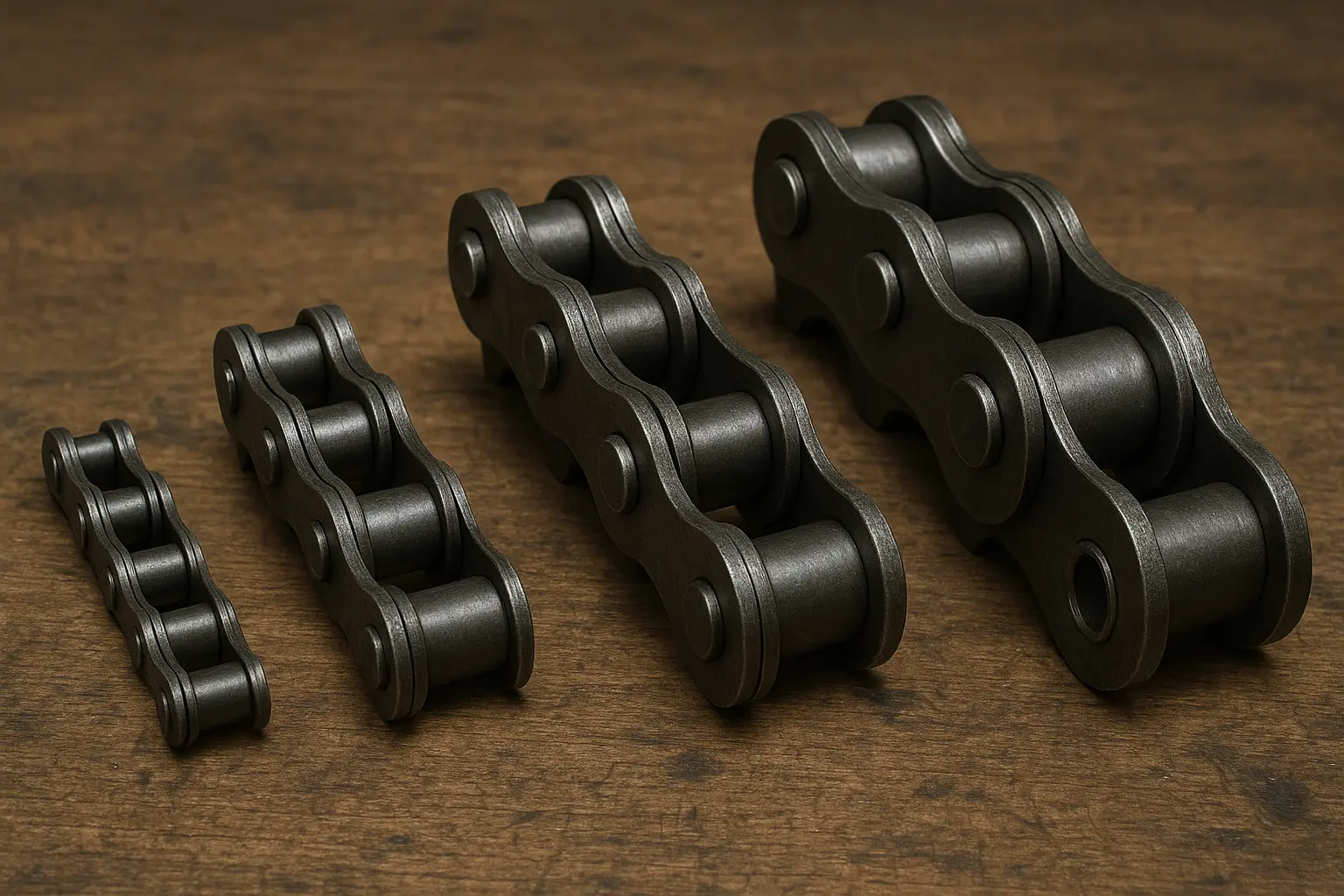
Chain Sizes Explained: Charts, Lengths & Dimensions

In the world of mechanical power transmission, few components are as critical—or as frequently misunderstood—as the industrial chain. Whether driving a conveyor belt in a packaging facility, powering agricultural machinery, or ensuring precise timing in an automated system, the chain is the unsung hero that keeps operations moving. However, simply “swapping out a chain” isn’t as straightforward as it sounds. Using the incorrect size or type can lead to catastrophic equipment failure, costly downtime, and significant safety hazards.
Correct chain sizing is fundamental to the longevity and efficiency of your machinery. A chain that is too small for the load will stretch and break prematurely. One that is too large may introduce unnecessary weight and friction, reducing system efficiency. Understanding how to read chain dimensions, interpret sizing charts, and calculate the appropriate length is essential for maintenance managers, engineers, and equipment operators alike. This guide breaks down the complexities of chain sizes, offering a clear path to selecting the perfect component for your application.
What Are Chain Sizes?
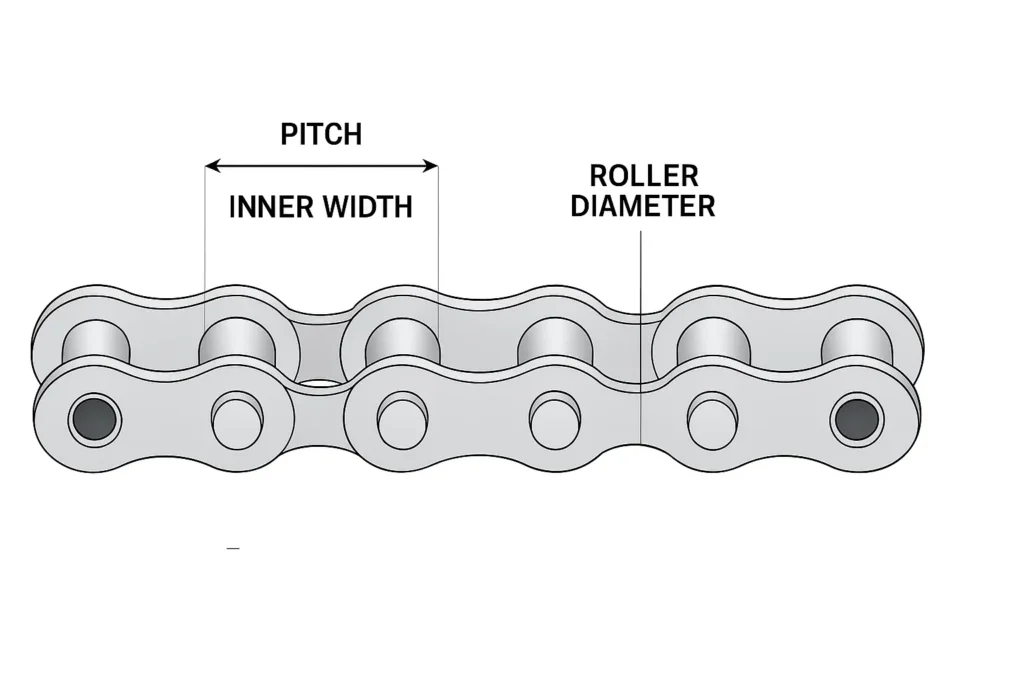
At its core, a “chain size” is a standardized designation that tells you the physical dimensions and load-bearing capabilities of a specific chain. In mechanical and industrial systems, these sizes aren’t arbitrary numbers; they are precise measurements that ensure a chain fits perfectly with a corresponding sprocket.
Chain size is primarily determined by three critical dimensions: pitch, inner width, and roller diameter. These measurements define the geometry of the chain and determine its compatibility with other drive components.
- Pitch: The distance between the centers of two adjacent pins.
- Inner Width: The distance between the inner plates where the sprocket teeth engage.
- Roller Diameter: The outside diameter of the roller that contacts the sprocket.
Standardization is the glue that holds the industry together. Without organizations like the American National Standards Institute (ANSI) and the International Organization for Standardization (ISO) establishing these sizes, finding a replacement part would be a nightmare of custom fabrication. Standardization ensures that an ANSI 40 chain bought from one manufacturer will fit an ANSI 40 sprocket made by another, facilitating easy maintenance and replacement.
Why Choosing the Correct Chain Size Matters
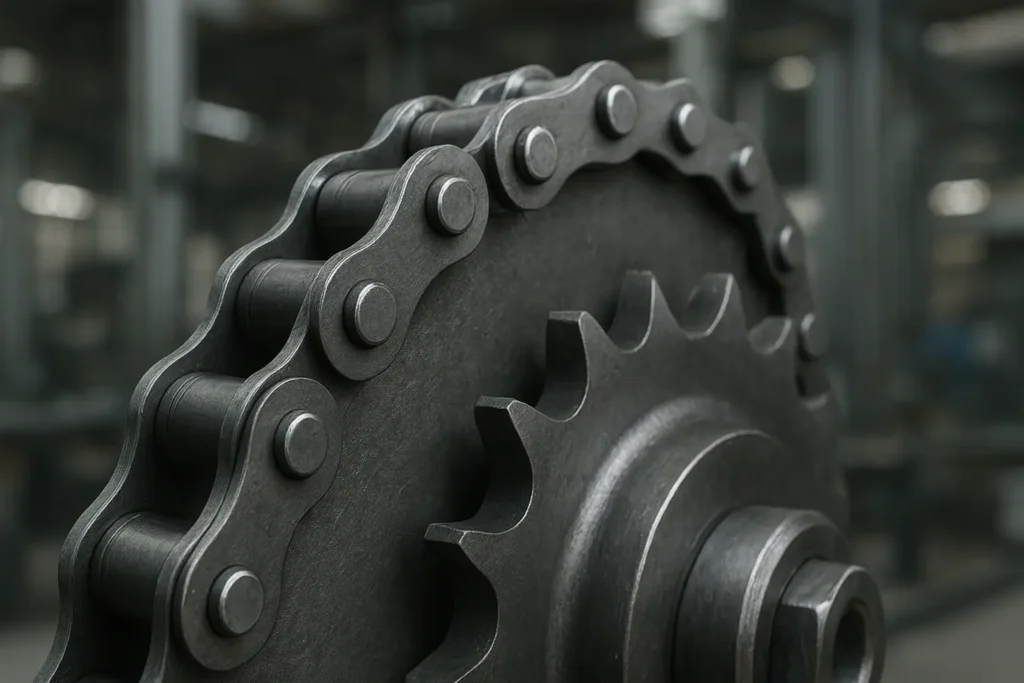
It might be tempting to use a chain that “looks about right,” especially during a breakdown when time is money. However, the consequences of improper sizing extend far beyond simple fitment issues.
Wear, Noise, and Vibration
A mismatched chain won’t sit correctly in the sprocket’s teeth. This poor engagement causes excessive friction, leading to rapid wear on both the chain rollers and the sprocket teeth. You’ll often hear this problem before you see it; a loud, clanking operation is a hallmark of improper sizing. This vibration doesn’t just annoy operators—it can loosen fasteners and damage sensitive components throughout the entire machine.
Sprocket Life and Load Handling
Sprockets are designed to work in tandem with specific chain geometries. If the chain pitch doesn’t match the sprocket pitch exactly, the load isn’t distributed evenly across the teeth. Instead of multiple teeth sharing the burden, the entire load might fall on a single tooth, leading to snapped teeth or a broken chain. Furthermore, chains are rated for specific working loads. Undersizing a chain for a heavy-duty application is a recipe for immediate tensile failure.
Cost and Downtime Risks
The most immediate impact of wrong sizing is financial. There is the direct cost of the ruined chain and sprocket, but the indirect costs are often far higher. Unexpected downtime stops production lines, delays shipments, and requires emergency maintenance labor. Investing time in selecting the correct size upfront is a cheap insurance policy against expensive operational failures later.
Understanding Chain Measurements
To navigate a chain catalog or a specification sheet, you need to speak the language of chain dimensions. While there are many sub-components to a link (pins, bushings, plates), three specific measurements define the “size.”
Pitch
Pitch is the most important measurement. It is the distance from the center of one pin to the center of the next pin. In ANSI standard chains, pitch is measured in eighths of an inch. For example, a #40 chain has a pitch of 4/8 inches, or 1/2 inch. If you get the pitch wrong, the chain simply will not wrap around the sprocket.
Inner Width
This is the width between the inner link plates. It determines the thickness of the sprocket tooth that the chain can accept. If the sprocket teeth are too wide, the chain won’t seat; if they are too narrow, the chain will slide side-to-side, leading to derailment or uneven wear.
Roller Diameter
This measures the round part of the chain link that sits in the bottom of the sprocket tooth valley. The roller must be the correct size to ensure smooth engagement and disengagement as the chain rotates. If the roller is too large, it won’t seat in the tooth root; if too small, it will wear prematurely.
These measurements collectively define the chain dimensions. When looking at a chain dimensions chart, you will see these three figures listed for every standard size, allowing you to cross-reference your existing chain to find a match.
Chain Size Chart Overview

A chain size chart is an indispensable tool for anyone working with power transmission. It serves as a dictionary, translating standardized numbers into physical reality.
Standard Classifications
Most charts divide chains into two main categories: ANSI (American National Standards Institute) and ISO/British Standard (International Organization for Standardization).
- ANSI Chains (B29.1): Common in the United States and parts of Asia. Sizes are usually denoted by numbers like 40, 50, 60, 80.
- ISO/British Standard Chains (Brake): Common in Europe. Sizes are often denoted with a ‘B’ suffix, such as 08B, 10B, 12B.
Decoding the Numbers
On an ANSI chart, the numbering system gives you clues about the chain’s dimensions.
- The first digit (or first two digits for sizes 100 and up) represents the pitch in eighths of an inch. (e.g., #60 chain = 6/8″ or 3/4″ pitch).
- The second digit indicates the type of chain. A ‘0’ indicates a standard roller chain, while a ‘1’ implies a lightweight chain, and a ‘5’ often indicates a rollerless bushing chain.
You should consult a chart whenever you are designing a new drive system or replacing an old chain where the part number has worn off. By measuring the pitch and width of your old chain with calipers, you can locate the corresponding row on the chart and identify the correct standard size.
Roller Chain Size Standards
Roller chains are the workhorses of the industrial world. They consist of alternating inner and outer links, with rollers that reduce friction as the chain engages the sprocket. They are used everywhere from bicycles and motorcycles to massive oil rig drives.
Standard Sizes in Industry
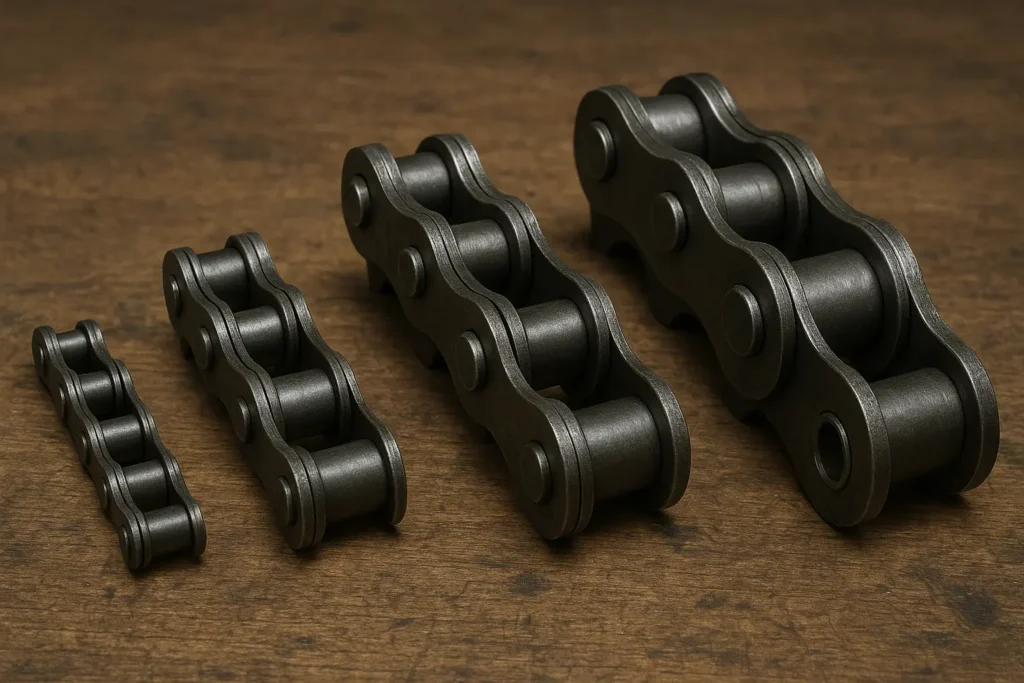
The most common industrial sizes range from small, light-duty chains to massive heavy-duty options.
- Small Pitch (#25 – #35): Used in light instrumentation, office equipment, and small conveyors. They are compact but have lower load ratings.
- Medium Pitch (#40 – #60): The “standard” for general industrial machinery, agricultural equipment, and automotive drives.
- Large Pitch (#80 – #240): Built for heavy lifting. You’ll find these on mining equipment, heavy earthmovers, and large lift conveyors.
Light-Duty vs. Heavy-Duty
Standard charts often differentiate between standard and “heavy” series (often denoted with an ‘H’, like 60H). Heavy series chains share the same pitch and width as their standard counterparts but feature thicker link plates. This doesn’t change the sprocket compatibility, but it significantly increases the chain’s ability to withstand shock loads and fatigue, making them ideal for harsh environments like rock crushing or forestry.
How to Read a Roller Chain Sizing Chart
Interpreting a roller chain sizing chart might look intimidating due to the wall of numbers, but it follows a logical flow. Here is a step-by-step approach to using one effectively.
- Identify the Pitch Column: Start here. Measure the distance between pins on your existing chain. Find the matching measurement in the “Pitch” column.
- Verify the Width: Move across to the “Inner Width” or “Roller Width” column. Ensure your chain matches this figure. This confirms you aren’t confusing an ANSI chain with a British Standard chain, as they can have similar pitches but different widths.
- Check Roller Diameter: Confirm the roller diameter matches.
- Review Tensile Strength: Once you have confirmed the physical dimensions, look at the “Average Tensile Strength” column. This tells you the maximum load the chain can handle before breaking. Ensure this exceeds your application’s requirements significantly (usually by a safety factor of 7-10 times the working load).
Matching to Sprockets
The chart will often list compatible sprocket face profiles. Remember: A #50 chain needs a #50 sprocket. You cannot mix sizes.
Load and Speed Considerations
Advanced charts may include horsepower ratings at specific RPMs. As the speed of the small sprocket increases, the chain’s capacity to transmit horsepower changes. Always check that your selected size is rated for the speed at which your drive will operate.
Chain Length Explained
Selecting the right size link is only half the battle; you also need the correct total length of chain. Chain length isn’t typically measured in feet or meters for purchasing; it is measured in the number of pitches or links.
Calculating Length
The length of a chain loop depends on the number of teeth on both the driver and driven sprockets and the center distance between the two shafts.
The formula involves:
- Half the number of teeth on the large sprocket.
- Half the number of teeth on the small sprocket.
- Double the center distance (measured in pitches).
- A small correction factor based on the difference in sprocket sizes.
Ideally, you want an even number of pitches. This allows for the use of a standard connecting link. If your calculation results in an odd number of links, you will need an “offset link” (or half-link), which is generally weaker than a standard link and should be avoided if possible.
Tension and Alignment
Correct chain length is vital for proper tension. A chain that is too tight places excessive load on the shaft bearings. A chain that is too loose will “whip” or jump teeth (ratchet). Most systems include a way to adjust the center distance to fine-tune tension, but getting the initial link count correct is crucial. A chain length chart or online calculator can save you from doing complex math manually, providing quick reference values for standard center distances.
Chain Size Guide for Common Applications
Different industries gravitate toward specific chain sizes based on typical loads and speeds. While every application is unique, here is a general chain size guide to point you in the right direction.
Conveyors
Conveyor chains often prioritize durability and attachment capabilities over high speed.
- Common Sizes: C2040, C2050, C2060 (Double Pitch Chains).
- Why: Double pitch chains have standard rollers but twice the pitch length, making them lighter and cheaper per foot for long conveyor runs.
Packaging Machines
Precision and cleanliness are often key here.
- Common Sizes: #35, #40, 06B, 08B.
- Why: These smaller pitch chains articulate smoothly around small sprockets, allowing for compact machine designs and precise movement.
Agricultural Equipment
Farming demands ruggedness and resistance to debris.
- Common Sizes: #50, #60, #80, and specific “Ag Chains” like CA550.
- Why: These sizes offer high tensile strength and can withstand the shock loads of harvesters and balers.
Industrial Automation
Robotics and assembly lines require high precision and low maintenance.
- Common Sizes: #25, #35, RS40.
- Why: Small pitch allows for precise positioning. Maintenance-free (lube-free) versions of these sizes are popular to prevent product contamination.
Common Chain Sizing Mistakes to Avoid
Even experienced pros make mistakes. Avoiding these common pitfalls can save thousands in replacement costs.
Choosing Chain by Width Only
Never measure just the width. An ANSI #40 chain and a British Standard 08B chain look incredibly similar, but their pitch and roller diameters differ slightly. If you buy based on width alone, the chain won’t seat on the sprocket.
Ignoring Load Ratings
Just because a chain physically fits doesn’t mean it’s strong enough. A standard #60 chain fits on the same sprocket as a #60H (heavy) chain, but the #60H handles fatigue much better. If your machine applies heavy shock loads, the standard chain will fail quickly.
Mismatching Chain and Sprocket Sizes
It sounds obvious, but putting a new chain on worn sprockets is a waste of money. As sprockets wear, the teeth become “hooked.” A new chain will not mesh correctly with these worn teeth, causing the new chain to stretch and fail rapidly. Always inspect sprockets when sizing a replacement chain.
Overlooking Chain Dimensions During Replacement
Assuming the old chain was the correct chain is risky. The previous technician might have installed the wrong size in a pinch. Always verify the application requirements rather than blindly replacing like-for-like.
How to Select the Right Chain Size
Before making your final purchase, run through this selection checklist to ensure you’ve nailed the specifications.
- Application Type: Is it a drive chain (transmitting power) or a conveyor chain (moving product)?
- Load and Speed: What is the horsepower? What is the RPM of the fastest shaft? High speed usually requires smaller pitch; high load requires larger pitch or multiple strands.
- Environment: Is it dusty? Wet? Hot?
- Dust/Grit: Sealed O-ring chains might be necessary.Moisture/Food: Stainless steel or nickel-plated chains prevent rust.
- Center Distance: Have you calculated the exact length needed?
- Consult the Experts: If your application involves high speeds, heavy shock loads, or safety-critical lifting, consult technical specifications or a manufacturer’s engineer.
Final Thoughts on Chain Sizes
Understanding chain sizes is about more than just reading a ruler; it’s about understanding the mechanical heartbeat of your facility. Charts, lengths, and dimensions are the roadmap to reliability. By taking the time to interpret chain size charts correctly and understanding the nuances of pitch and diameter, you ensure that your equipment runs smoother, quieter, and longer.
Don’t guess. Measure, verify, and consult the guides. The extra ten minutes you spend verifying the dimensions today will save you hours of downtime tomorrow. Whether you are designing a new conveyor or fixing a combine harvester, let the data drive your decision, and choose the chain that fits not just the sprocket, but the job.